

Why this page,
why this picture,
why these words.
I read law. Then I had a baby. The two turn out to be related: you learn to ask what a thing is actually doing, and you learn that a small person will make you prove it. So I kept notes while this book was written. The question, the reasoning, the authority, and a line where the authority stops.
The brief
The surah asks that of three ordinary things: the crop, the water, the fire. Each time your part is granted, and the part that matters is not yours.
with one seed in his hand
Yusuf sows, which the verse grants him. He cannot do the growing, which the verse denies him. The story is the verse at the size of a garden bed.
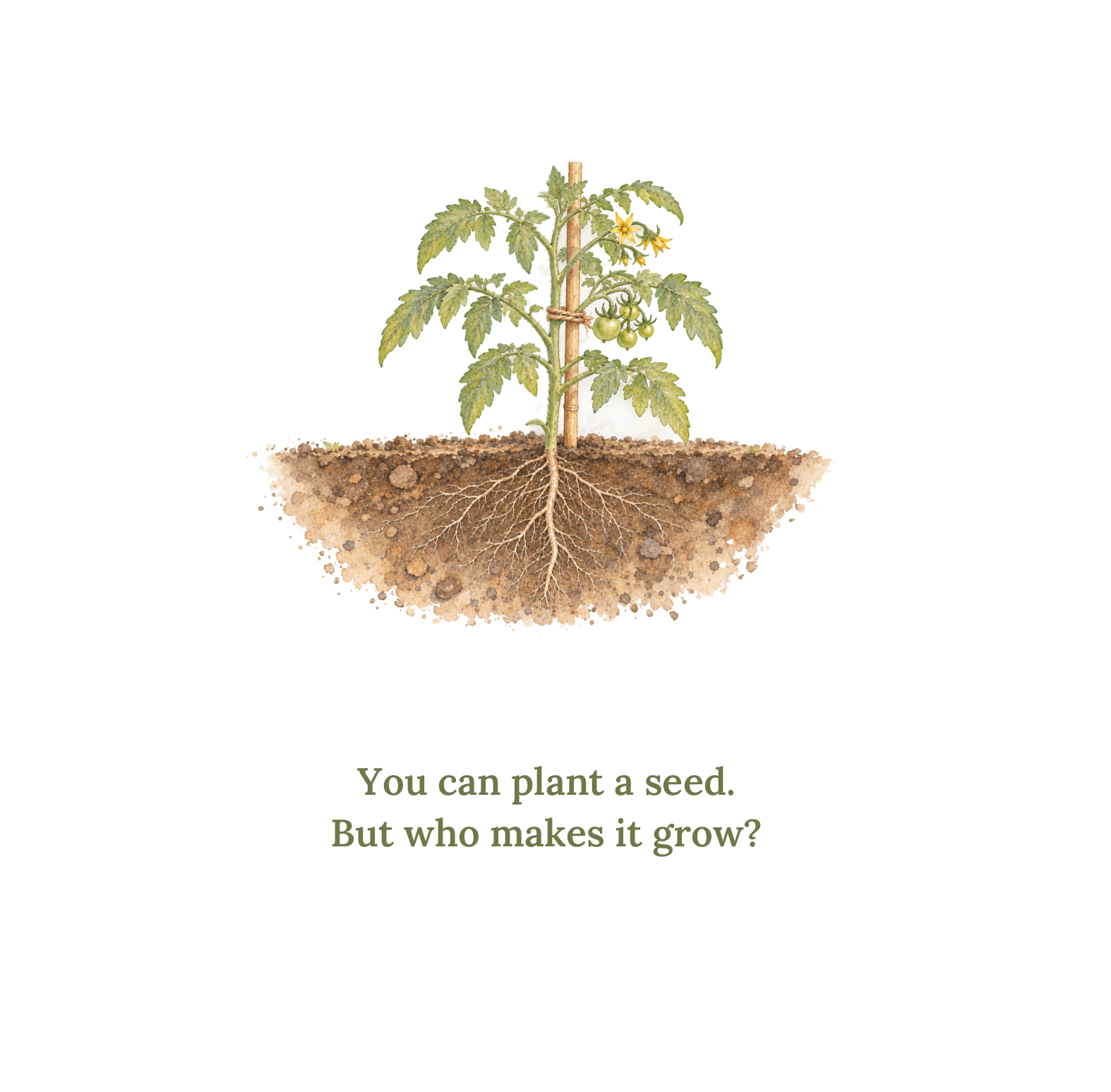
A three year old cannot hold an idea, but she can hold a seed. She can also see that nothing happened on Tuesday. see study: Fyfe 2014
Being short of something narrows what a mind can notice. see study: Mani & Shafir 2013 Teach her the supply is tight and she watches the supply. Teach her it is given and she watches the Giver.
and Allah’s
Page by page
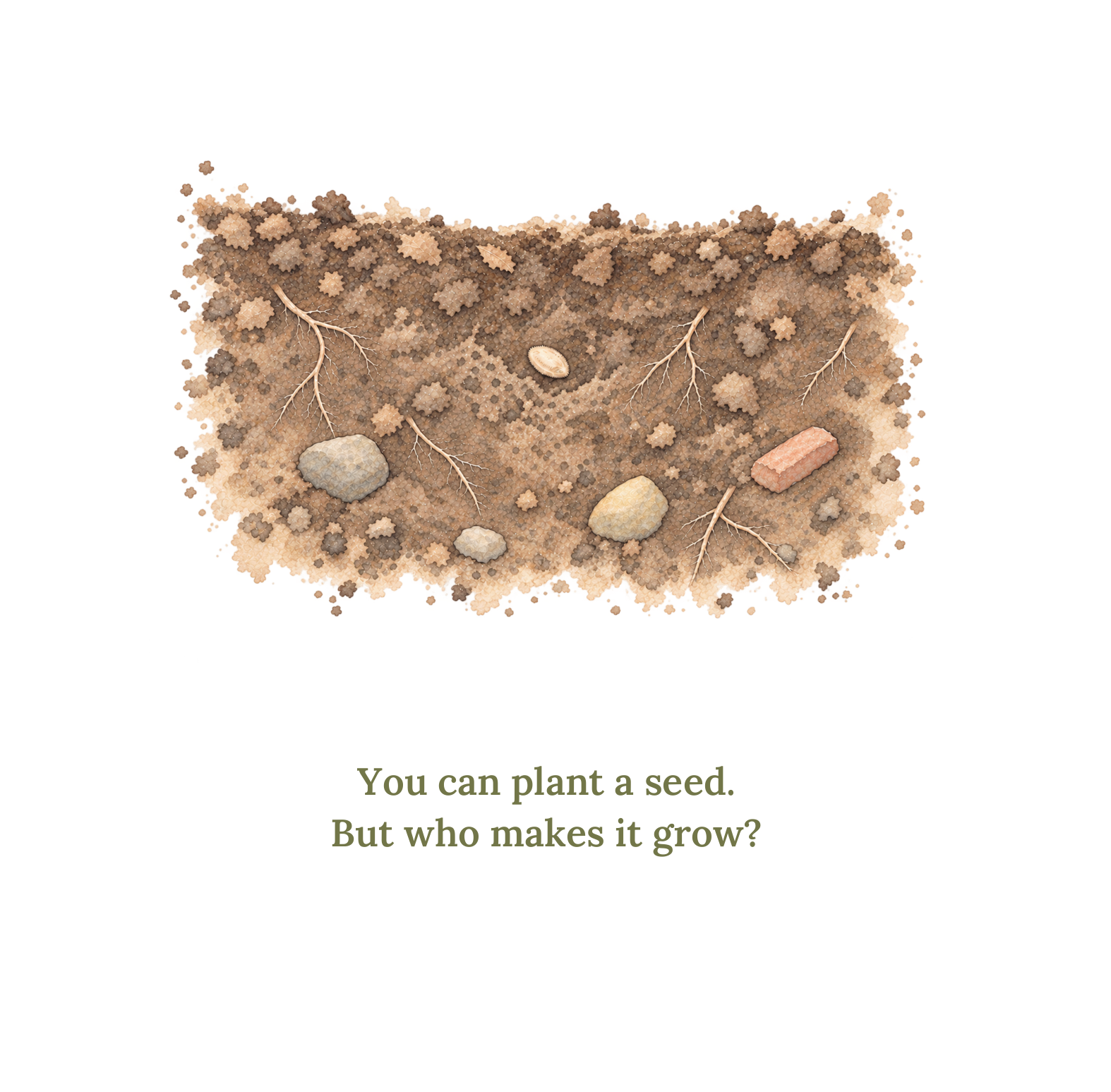
Pale and flat, hardly bigger than a crumb. If the seed already looked promising there would be nothing to explain. Yusuf even asks it a question, and it says nothing at all, which is the first honest joke in the book.
Two heads bent over one small thing, at her height. How much a young child gets from a book depends more on the way you read it together than on the book itself. see study: Bus 1995 So the pictures are made for you too. A page like this makes you want to sit close and look with her, which is the whole trick.
One picture to a page, never two fighting for her eyes. Children learn new words better from a single picture, and worse when something on the page is built to grab them. see study: Flack & Horst 2018
Three year olds who heard one story three times remembered more new words a week later than children who heard three different stories with the same words in them. see study: Horst 2011 Once she knows what happens next, she has room to notice what it means.
A question leaves a gap, and a small child cannot leave a gap alone. By the third reading she answers before you do. Books that get a child talking do more for her than books that talk at her. see study: Whitehurst 1988
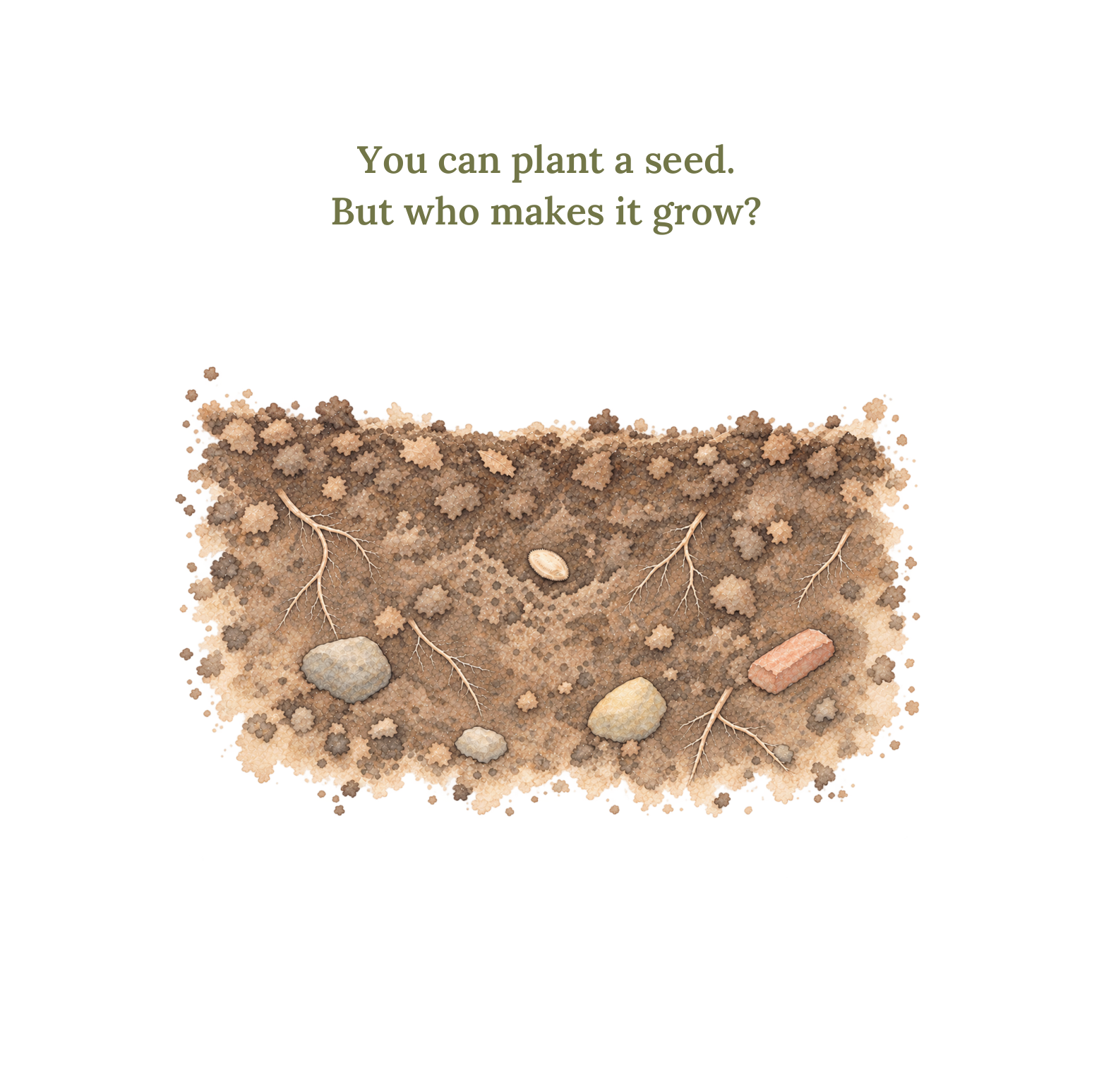
The refrain page asks, and then waits. The answer comes later, from Baba, after she has watched a seed do something she knows she could not do. Small children already assume somebody is behind the way nature works. see study: Kelemen 2004 The book is not planting that idea. It is telling her the right name for it.
before you do
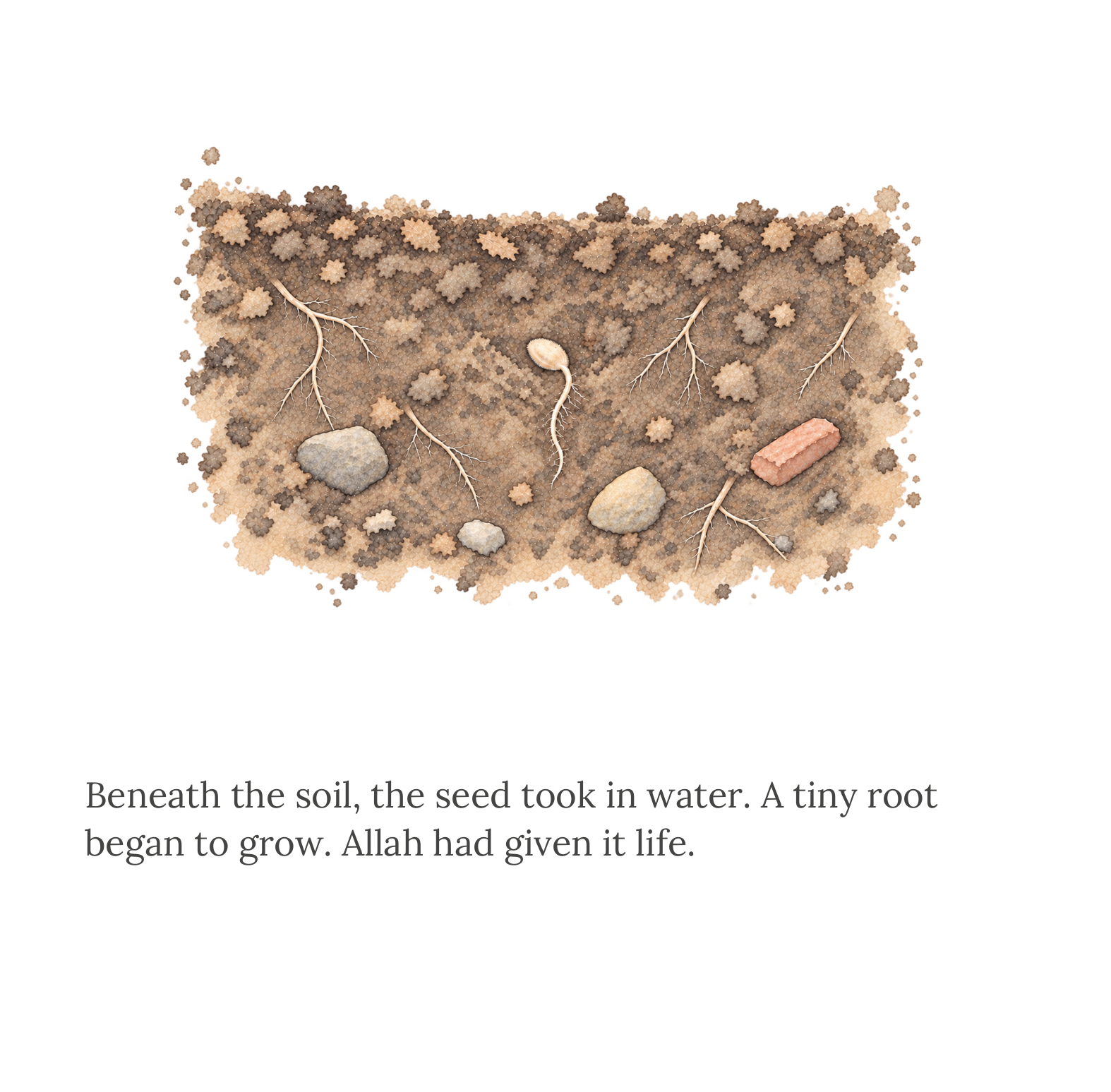
If the book jumped straight from planting to tomatoes it would teach her two wrong things at once: that good things come instantly, and that she made them come. Anything yet? Still nothing. The waiting is not filler. It is the argument.
“Be patient,” she says. Children are not gullible; they weigh up who is telling them, and they accept things they cannot see for themselves from people they already trust. see study: Harris & Koenig 2006 So the part she cannot see is said by her grandmother, standing in a garden she can.
How well a child waits depends mostly on whether waiting has been worth it before. see study: Kidd 2013 Every time you read this book, the waiting ends in a shoot. That is where the trust comes from, not from anyone telling her to trust.
You planted it and cared for it. Allah gave it life and made it grow. Take away the first half and her own effort stops mattering. Take away the second and she grows up thinking everything good came from her. The surah keeps both halves, so the book does too.
Baba knelt beside him. The biggest line in the book is said at his eye level, in the middle of his excitement, and not as a correction. Yusuf has just shouted about it. Nobody tells him to calm down.
One plain sentence about what he could not do. He could water the soil, but he could not command the rain, paint the leaves green or pull the seed into life. Then, beneath the soil: Allah had given it life. She needs to meet that limit gently, and once is enough.
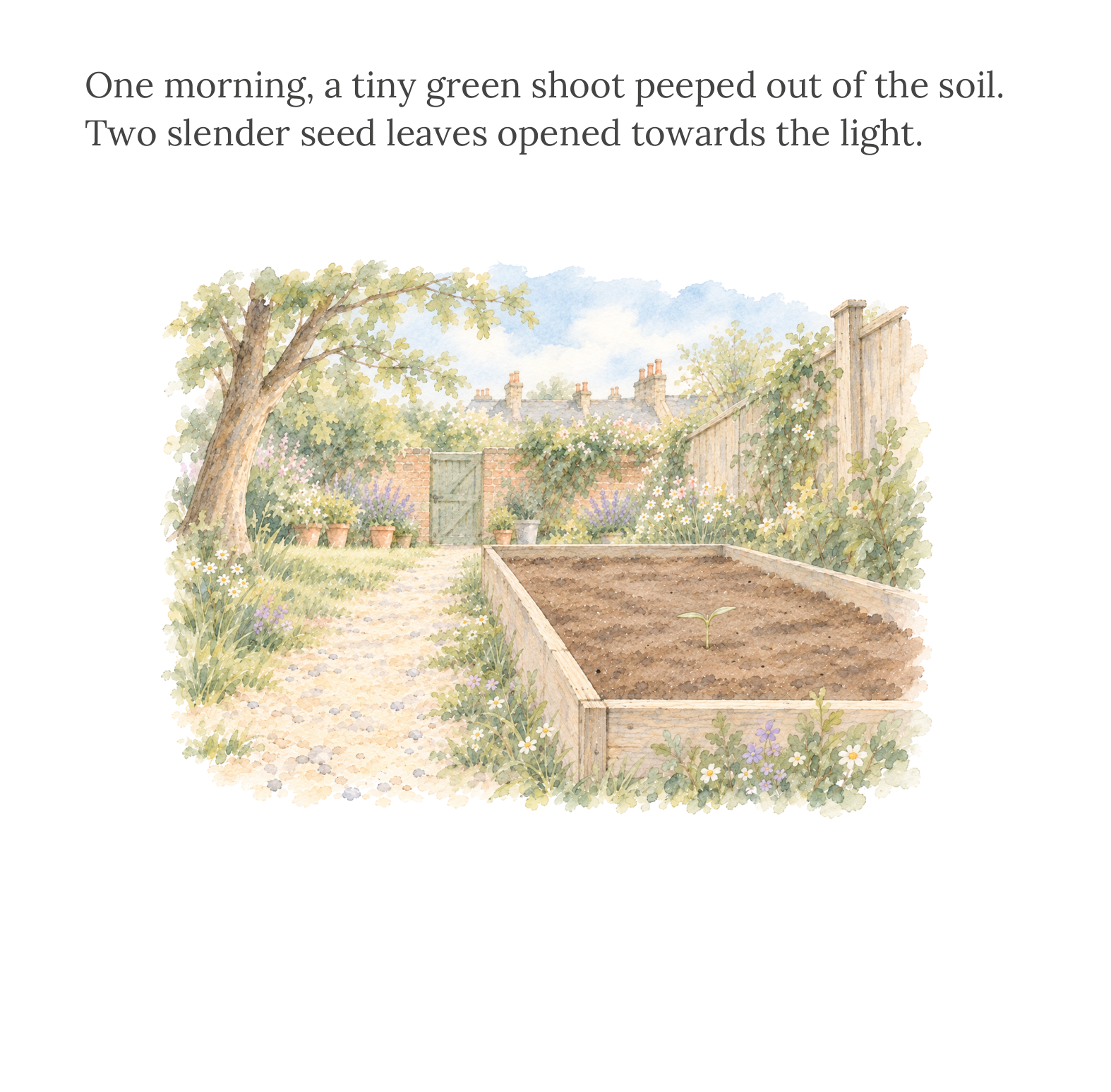
One seed comes back as a whole basket. The word abundance never appears in this book. It shows up as too many tomatoes, which is something a four year old can actually count.
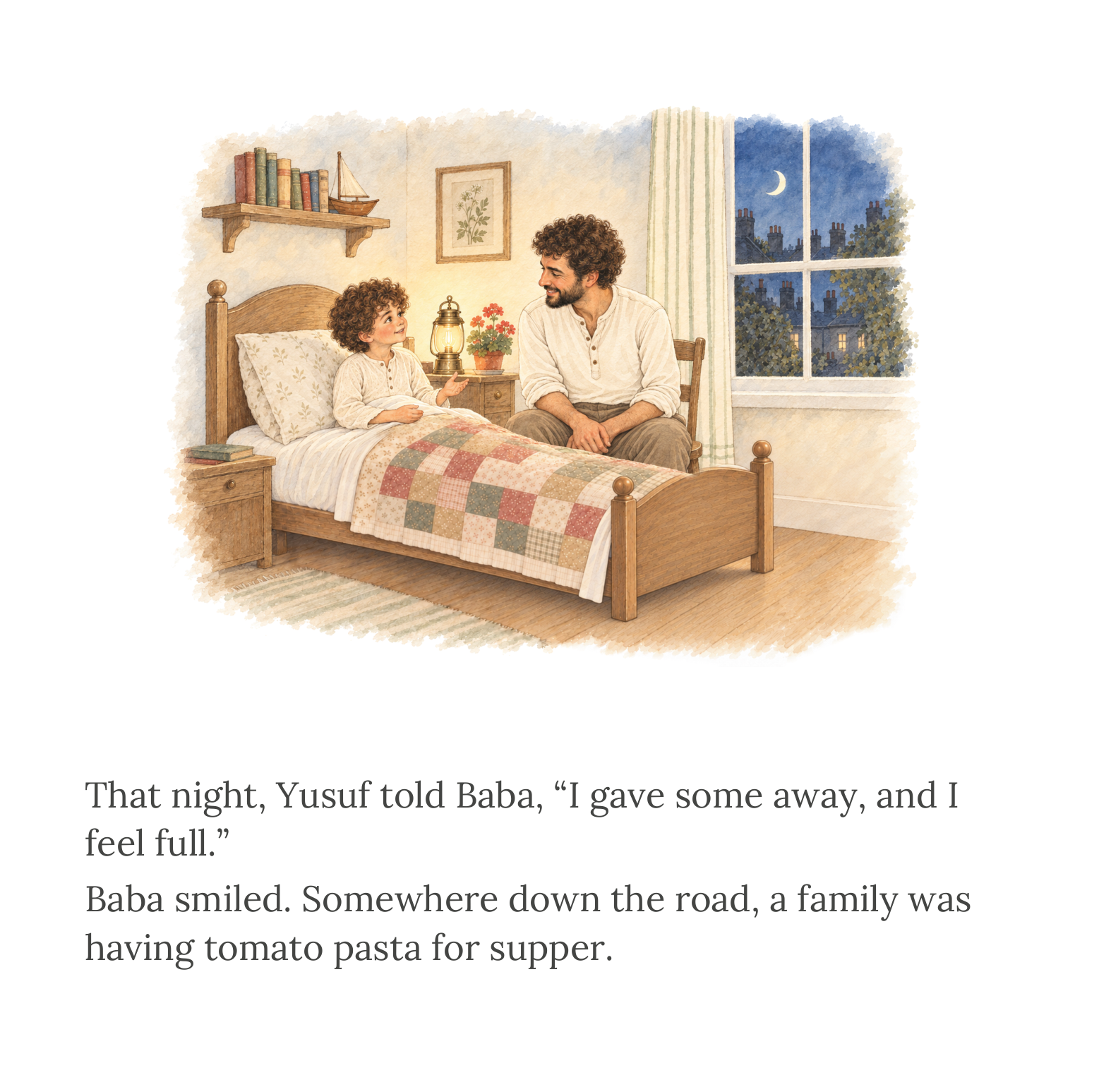
Because thankfulness that stays inside you is just a mood. Thankfulness that walks next door is a habit. Children who are asked to notice and count what they have been given end up happier than children who are not. see study: Froh 2008 Aunty Mariam gets the tomatoes, and a family down the road gets supper.
He walks home with an empty basket and a warm feeling inside. The good feeling is described in his terms, and it turns up after he gives, never as a deal made beforehand.
Surah Al Waqiah, named on the closing page, after the story rather than before it. A name for something she has already felt is useful to her. A name given first is just homework.
The hadith about planting, that whatever people, birds or animals eat from it counts as charity, is printed for you, not read out to her. It is there so you can see the story came from somewhere, and was not made up to make a point.
What would you like to plant and care for? It looks like a line for the child. It is really an instruction for the grown up. Reading where the adult asks and the child answers gives the largest language gains of anything we can control from a page. see study: Mol 2008 And what she says out loud afterwards is what she keeps. see study: Fivush 2006
Why so young
Brains are most open to being shaped by experience during particular windows, and what is built then is what everything later sits on. see study: Knudsen 2004 A child of four is not too small for the idea that provision is given. She is exactly the age at which it can stop being an opinion and become an assumption.
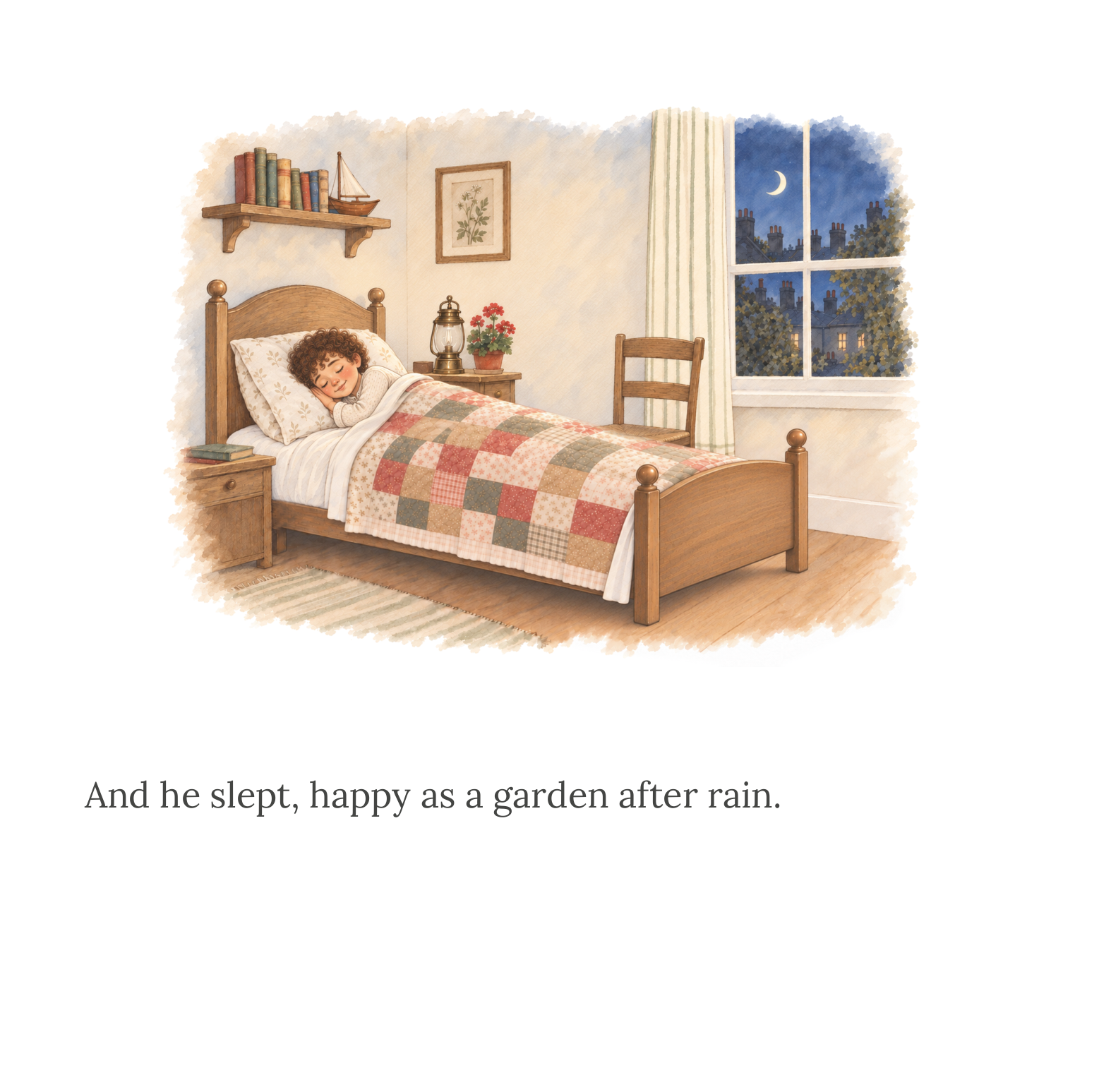
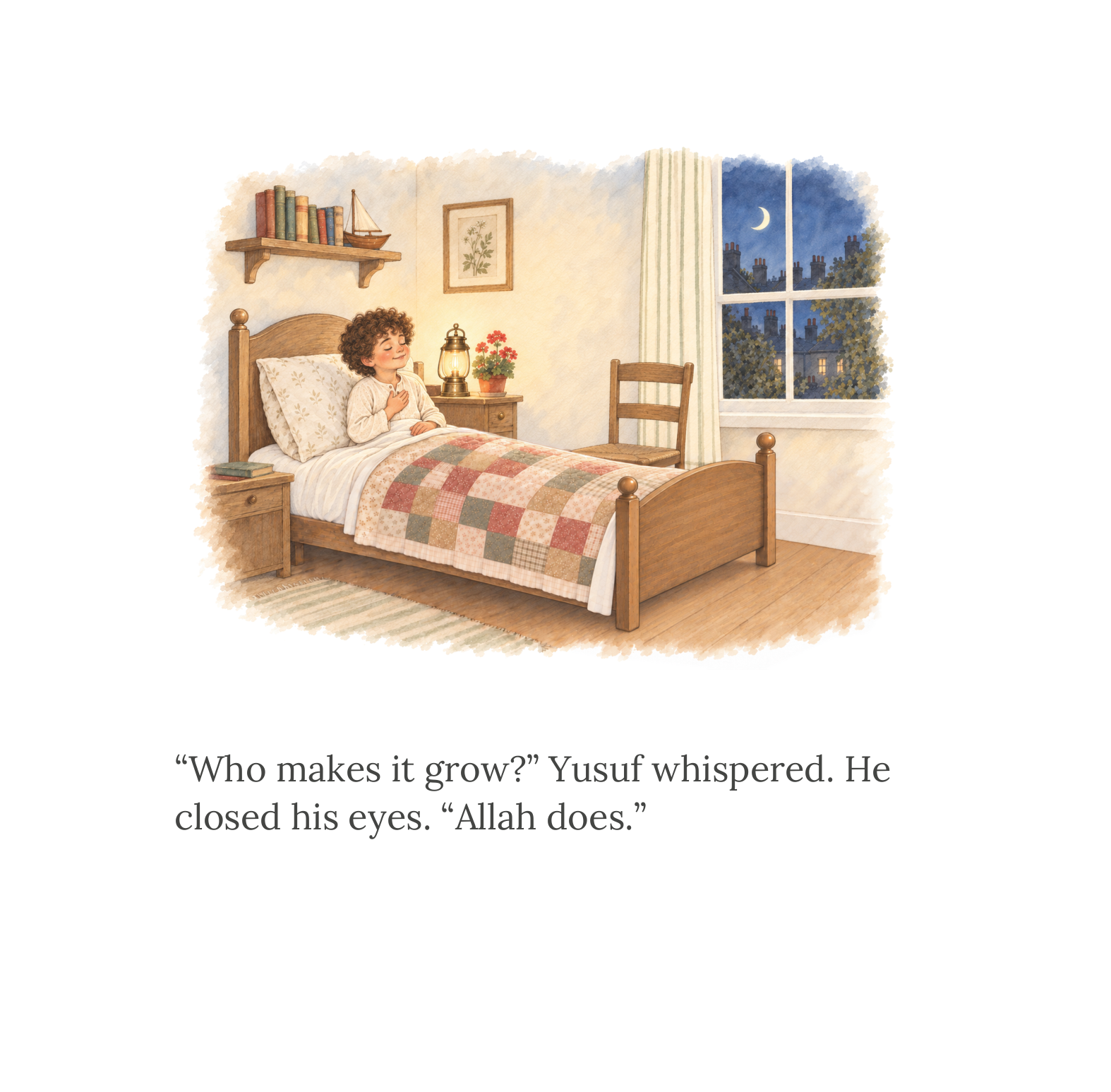
She will carry an idea out of a book and try it on the world, but only if the book looks like the world.
toddlers applied what they learned from a realistic picture book to the real object. The less realistic the picture, the worse the transfer.
Hence watercolour rather than cartoon, a real London garden, a real tomato plant, and a boy who could be next door.

Six books, one idea each. Nothing is crowded, and nothing is taught at her.
informal storybook exposure at home predicted children’s vocabulary five years on. Formal drilling of print did not.
Which is a relief, because the bedtime that does the most is the ordinary sort, on the sofa, with nobody testing anybody.
At this age she asks in order to get answers, not attention.
preschoolers’ questions are genuinely information seeking, and they keep re asking until the answer they get actually fits.
So every book leaves her somewhere to put a question, and every closing page hands one back to her instead of closing the subject.
leave the growing.
Left out on purpose
The question has already been asked five times. A closing lesson would only tell her she has been the subject of one.
Nothing goes wrong in this book. The only tension is between wanting and waiting, which is the tension the surah is actually about.
Features built to grab a child reliably reduce what she takes from the page they sit on. see study: Tare 2010 Every one of them was cut on that basis.
No warning, no punishment. A three year old learning that Allah gives should not also be learning to be afraid of Him. There is time. This is not that book.
One name, once, on the closing page. The story stays in her own language so the idea is the work, not the vocabulary.
was cut so one idea
had room to land
Seventeen studies, and one surah.
The pen notes above point to the work each choice rests on. Peer reviewed developmental research, cited for the shape of the book only. The theology is from Al Waqiah and needs no footnote.

and it does not stay this open for long
Knudsen 2004, on sensitive periods
Full references, for anyone who wants them ›
Bus, van IJzendoorn and Pellegrini, ‘Joint book reading makes for success in learning to read’ (1995) 65 Review of Educational Research 1.
Chouinard, ‘Children’s questions: a mechanism for cognitive development’ (2007) 72(1) Monographs of the SRCD.
Fivush, Haden and Reese, ‘Elaborating on elaborations’ (2006) 77 Child Development 1568.
Flack and Horst, ‘Two sides to every story’ (2018) 23 Infant and Child Development e2047.
Froh, Sefick and Emmons, ‘Counting blessings in early adolescents’ (2008) 46 Journal of School Psychology 213.
Fyfe, McNeil, Son and Goldstone, ‘Concreteness fading’ (2014) 26 Educational Psychology Review 9.
Ganea, Pickard and DeLoache, ‘Transfer between picture books and the real world’ (2008) 9 Journal of Cognition and Development 46.
Harris and Koenig, ‘Trust in testimony’ (2006) 77 Child Development 505.
Horst, Parsons and Bryan, ‘Get the story straight’ (2011) 2 Frontiers in Psychology 17.
how I write for him
Kelemen, ‘Are children intuitive theists?’ (2004) 15 Psychological Science 295.
Kidd, Palmeri and Aslin, ‘Rational snacking’ (2013) 126 Cognition 109.
Knudsen, ‘Sensitive periods in the development of the brain and behavior’ (2004) 16 Journal of Cognitive Neuroscience 1412.
Legare, Evans, Rosengren and Harris, ‘The coexistence of natural and supernatural explanations’ (2012) 83 Child Development 779.
Mani, Mullainathan, Shafir and Zhao, ‘Poverty impedes cognitive function’ (2013) 341 Science 976.
Mol, Bus, de Jong and Smeets, ‘Added value of dialogic book readings’ (2008) 19 Early Education and Development 7.
Sénéchal and LeFevre, ‘Parental involvement in the development of children’s reading skill’ (2002) 73 Child Development 445.
Tare, Chiong, Ganea and DeLoache, ‘Less is more’ (2010) 31 Journal of Applied Developmental Psychology 395.
Whitehurst and others, ‘Accelerating language development through picture book reading’ (1988) 24 Developmental Psychology 552.
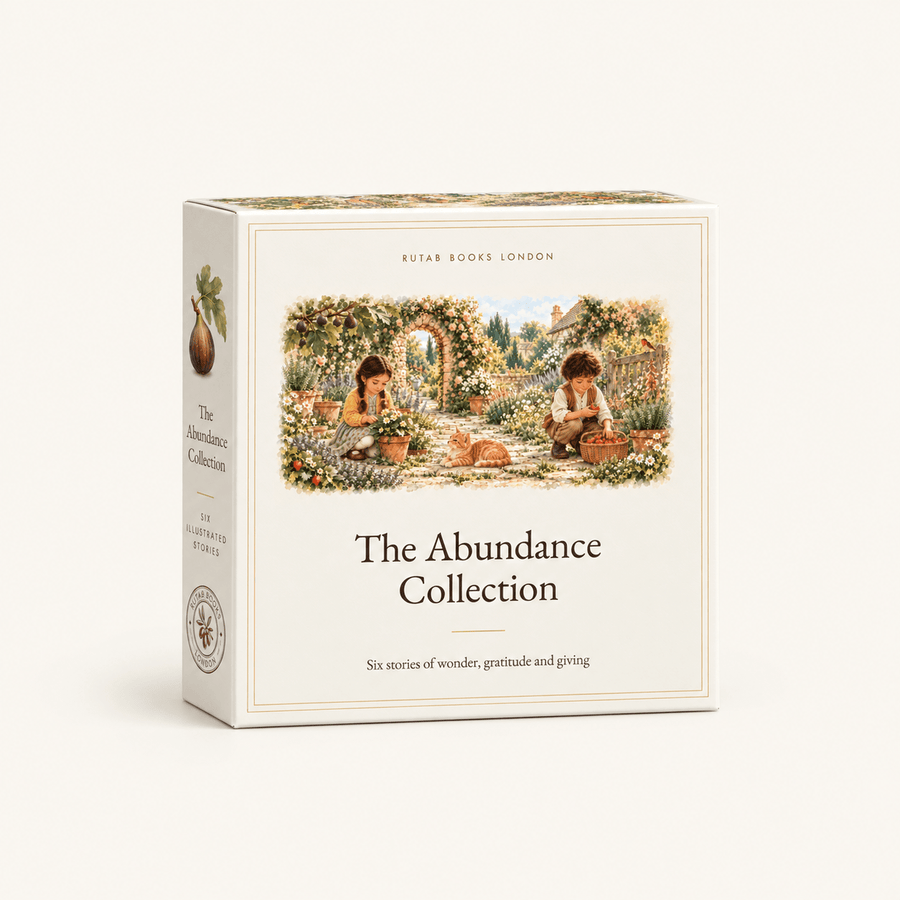
The Abundance Collection · First Edition
Bring all six home, together
Who Makes It Grow? and its five companion stories, as hardbacks in a collector's slipcase. Complimentary delivery, dispatching November 2026.
£84for the complete set of six
Reserve nowWe'll tuck the set straight into your basket, ready whenever you are.